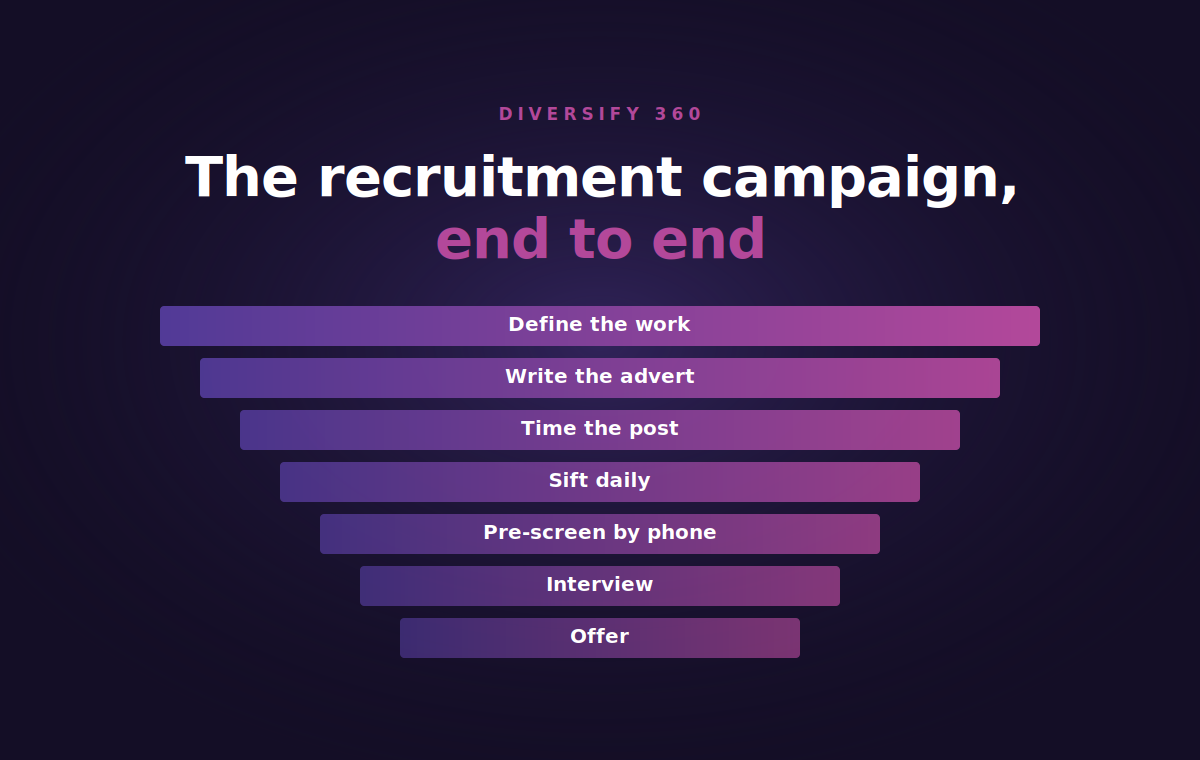
Running a recruitment campaign properly means defining the work before writing the advert, writing the advert to one person rather than the market, posting it at the start of the week and running it to a closed window, sifting daily against fixed criteria, pre-screening by phone before anyone sits in a room, interviewing for evidence rather than personality, and structuring the offer so both sides win. Most business owners have never been shown any of it.
Ask an owner how many times they have hired someone. Most will say a handful. Ask them how many times they have been trained to hire someone, and the answer is almost always none.
That is the gap. Recruitment is treated as an administrative task that happens when someone leaves, when it is actually one of the highest-leverage commercial decisions a business makes. A good hire quietly removes friction for years. A bad one costs you salary, management time, customer goodwill and momentum, and you usually carry them for six months longer than you should because nobody wants to admit the process failed.
I have run two full campaigns recently through Diversify 360. One for an office manager at AVA Waste Management, and one for an operations manager at BB Exclusive Fabrications, where the new hire started this week.
We couldn't have achieved such a successful campaign without you. John Turner, Owner, AVA Waste Management
On both I did the heavy lifting and walked the internal team through each stage as we went. That is deliberate. The first campaign is the one where the owner is under pressure, has never done it properly before, and cannot afford to get it wrong, so it makes sense for me to carry it. The next one is different. AVA will run their own and I will coach them through it. At BB we will fill in whatever gaps show up when they do it without me. Both are already far more confident than they were, which is the actual measure of whether the work landed.
Here is what that process actually looks like.
Where should a recruitment campaign start?
Start with the work, not the job title. The first mistake is writing a job advert. The first job is defining the work. What does this person actually do on a Tuesday? What comes off someone else's plate when they arrive? What does the business get in return for the salary?
Most owners hire a title because they feel overloaded, then discover three months in that the role was never designed, only felt. So you end up with someone capable sat in a seat with no clear remit, and everyone quietly disappointed. At AVA, the office manager role existed to take structured work off the operations director and give the admin function an owner. At BB, it existed to pull scattered job information out of whiteboards, phones and laptops and into one place. Both were defined by the problem they solved, not by a title lifted off a job board.
Once you can describe the work in plain terms, you can describe the person. Not a wish list of ten years' experience in your exact sector, which is usually just laziness dressed up as standards, but the two or three attributes that genuinely predict success in that seat.
How do you write a job advert that attracts the right people?
Write to one person, not the market. Job adverts fail because they read like a legal document with a bit of corporate optimism sprinkled on top, and they attract volume rather than fit.
Be specific about the environment, the pace, the messiness, the autonomy, the constraints. Say what will be hard about it. Counterintuitively, honesty about the difficult parts increases application quality, because the right candidate reads it and thinks that sounds like me, and the wrong one self-selects out. That is screening happening before you have spent a minute of your own time.
Be straight about money too. Vague salary ranges signal either that you have not decided or that you intend to negotiate downwards. Both put off the people you want most.
When is the best time to post a job advert?
Post on a Sunday evening or early Monday. Job boards refresh, people plan their week, and the first forty-eight hours carry most of the traffic. An advert posted on a Thursday afternoon is already stale by the time anyone with intent is looking.
Run it as a campaign, not a permanent listing. A defined window creates urgency for the candidate and forces discipline on you. Open-ended adverts drift, applications trickle in, nobody reviews them properly and the whole thing dies quietly after five weeks. Set the window, run it hard, close it.
How do you filter through a high volume of CVs?
Sift daily and filter hard. The volume arrives fast and it is mostly noise. If you leave it a week you will be facing ninety CVs, and at that point you will either skim badly or avoid it entirely.
Review every day. Apply a small number of non-negotiable filters first, usually location, availability and one or two hard requirements, and clear those out quickly. Then score the remainder against the attributes you defined at the start rather than against how impressive the CV looks. CVs reward people who are good at writing CVs, which is a genuinely useful skill for approximately no roles in a small business.
Keep the shortlist tight. Ten to twelve for pre-screening, four to six for interview.
What should a pre-screening call cover?
A ten to fifteen minute phone call tells you more than any CV, and this is the step most owners skip. You are testing four things. Motivation, meaning why this role and why now, because someone who cannot answer that clearly is applying to everything. Money, so you find out early whether expectations are compatible rather than discovering it after three interviews. Logistics, covering notice period, commute, hours, holidays already booked. And how they hold a conversation, because in most small business roles that is the job.
Half your shortlist will fall away on this call, and they will fall away cheaply. That is the point.
How should you structure the interview?
Interview for evidence, not personality. Every interview should follow the same structure and the same core questions. Not because structure is exciting, but because without it you are comparing feelings rather than candidates, and feelings favour whoever interviewed most recently or reminded you most of yourself.
Ask for evidence. Not what would you do, but what did you do, when, and what happened afterwards. People can theorise convincingly about situations they have never been in. They struggle to invent detail about ones they have.
Leave silence. Most candidates fill it, and what they fill it with is usually the most useful thing they say all interview.
How do you negotiate an offer with a senior candidate?
Negotiate towards a win win, not a win. At the senior end, negotiation is where a good process gets thrown away. Owners get competitive, squeeze a couple of thousand out of the offer, and start the relationship with someone who feels undervalued before their first day. You won the negotiation and lost the hire.
Understand what the person actually wants. Sometimes it is money. Often it is flexibility, security, progression, or a clear path to a review with defined goals attached. Structure the offer around that. Put a starting rate in place with agreed targets and a review date, and both sides get something. The candidate gets a route to the number they asked for. The business gets performance before it pays for it.
Then put it in writing properly. Offer letter, written statement of particulars, all of it clear before they hand in their notice. The cost of getting this wrong is losing the person you just spent six weeks finding.
Should you outsource recruitment or learn to do it in house?
Both, in that order. Running one good campaign solves one problem. Handing the process over solves the category.
The model is straightforward. I run the first one properly while the team watches every stage and understands why each decision was made. They run the next one and I coach from the side, catching the gaps rather than doing the work. That is where the confidence gets built, because watching someone do it well is useful, but doing it yourself with support is what makes it stick.
At AVA and BB the internal staff now know how to define the role, write the advert, time the post, sift, pre-screen, interview and structure an offer. Next time they need someone, they are not starting from instinct and a job board template. That is the difference between buying a hire and building a capability.
Recruitment is not a talent. It is a system, and like every other system in a business, it either exists or it does not. If it does not, you are relying on luck and calling it judgement.
If your last hire was harder than it should have been
Diversify 360 runs full recruitment campaigns for owner-managed businesses across Yorkshire and the North West, and trains your team to run the next one themselves. Book a 30 minute call and we will look at the role you are trying to fill, what it is actually costing you to leave it open, and whether this is a campaign to run or a capability to build.
About Richard Firth
Richard Firth helps owners of £1M to £10M businesses turn operational chaos into controlled growth. Through practical coaching, advisory, and mentoring, he helps leaders build systems that scale and finally reclaim control, profit, and peace of mind.
.jpg)
.jpg)