What Does a Business Coach Actually Do?
A business coach sets direction, forces priority, challenges honestly and holds you accountable. What that looks like session by session, and what it costs.
Coaching and Mentoring
August 28, 2026
A business coach sets direction, forces priority, challenges honestly and holds you accountable. What that looks like session by session, and what it costs.
A business coach works one to one with an owner to set a clear direction for the company, break it into priorities that can actually be delivered, and hold the owner accountable for doing them. In practice that means structured sessions on a regular cadence, an agreed written plan, honest challenge, and someone whose job is to notice when the plan quietly stops happening.
That is the short answer. The longer one is more useful, because most descriptions of business coaching tell you what a coach is like rather than what a coach does, and you cannot buy a vibe.
I have been on both sides of this. I have built five businesses and sold three. I now coach owners of UK businesses turning over roughly £1m to £5m who are building towards £10m.
If you already know the problem is that different parts of your business are pulling in different directions, you can skip the reading and score yourself now. The Business Alignment Scorecard takes a few minutes and emails you a personalised report across eight areas of the business. Free, and there is no pitch attached to it.
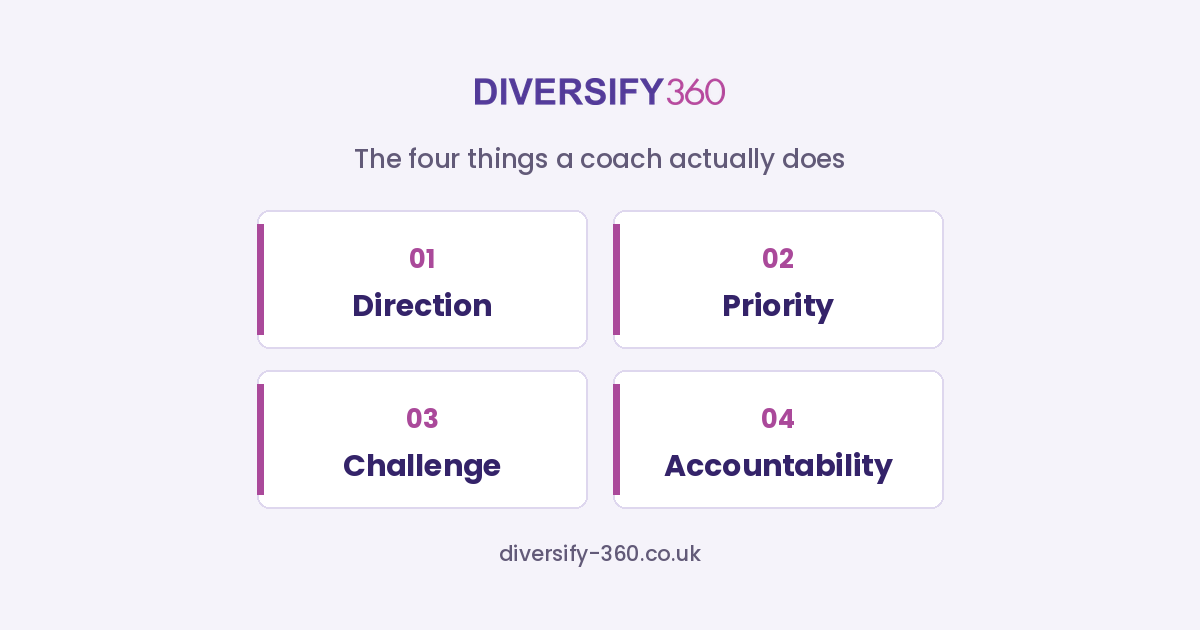
Four things, in roughly this order of importance.
Direction. Most owners have a plan. Very few have it written down, and almost none have it broken into something a Tuesday morning can be measured against. The coach's first job is to get the thing out of your head and onto paper in a form the business can act on.
Priority. There is never a shortage of good ideas. There is a permanent shortage of the attention needed to finish any of them. A lot of coaching is deciding what not to do, which owners find harder than deciding what to do.
Challenge. Owners are surrounded by people who work for them. That is a structural problem, not a comment on the people. The coach is the one person in the room with no career risk in telling you that your explanation for why revenue is flat does not hold up.
Accountability. Not nagging. Structure. Actions with owners and dates, reviewed every session, documented so that in a year you can see what actually changed rather than relying on memory, which is generous to all of us.
Every session follows the same shape, which sounds dull and is exactly why it works.
1. What has happened. Since the last session. Facts before feelings.
2. What has not happened. The actions that did not get done, and why. The reason is usually more informative than the action.
3. Priorities. What needs to move next, and what we are going to do about it.
4. Actions. Specific, owned, dated. Vague actions are how plans die.
I set my stall out early with every client: we work at your pace. If you want to move faster, say so. If it is too much, say that too. I would far rather be told than left to guess, because an owner who is quietly overwhelmed disappears rather than complains.
Between sessions the work is yours. That is not me offloading. It is the point. If I did it for you, nothing in the business would have changed by the time I left.
This is the part almost nobody publishes honestly, so here is how I run it.
Weeks 1 to 8: understanding the business. Not a diagnostic questionnaire. Actually getting to know it. The people and what they really do, as opposed to what their job title claims. The numbers. The customers. What the owner personally wants out of this, which is frequently different from what they said in the first meeting.
I deliberately resist fixing things in this window. Early advice is usually confident and wrong.
Life & Business Five Year Vision Alignment: a full day, off site. A neutral room and a full day on it. We map the five year vision across three areas, business, professional and personal, because owners who only plan the business end up resenting it. Then we work backwards. Five years down to an 18 month plan, because beyond 18 months too much changes to plan credibly. The 18 months breaks into 90 day blocks. The 90 days break into weekly actions.
The purpose is that the thing you do on a Tuesday morning is traceable to the thing you said you wanted in five years. Most businesses lose that thread within a fortnight of any planning exercise.
Weeks 9 onwards: execution and accountability. Regular sessions against the 90 day goals, everything documented, progress visible.
That first eight weeks is diagnostic, and it is the part you can start on your own. The Business Alignment Scorecard scores your business across the same eight areas I look at with a new client, and shows you which ones are working against each other. Free personalised report, straight to your inbox.
Every buyer runs this comparison in their head. Almost nobody publishes it plainly.
A business coach works with you on direction, priorities and execution. You get a clearer plan and the discipline to deliver it. Best when you know roughly what needs doing and it keeps not getting done.
A consultant does the work and delivers a recommendation or a project. You get a deliverable. Best when you need a specific thing built or analysed and you do not have that capability in house.
A mentor shares experience. Less structured, longer view. You get perspective from someone who has been there. Best when you need judgement rather than process.
A non-executive director brings governance, board level oversight and accountability to shareholders. You get formal scrutiny and a network. Best when you have a board, investors or a governance requirement.
A peer group gives you structured problem solving alongside other owners. You get perspective, benchmarking, and the discovery that you are not uniquely broken. Best when isolation is the main problem.
The honest version: these overlap, and anyone telling you the boundaries are clean is selling one of them.
My own practice deliberately spans coach, mentor, trainer and executive coach. That is not a claim to be five things at once. It is because problems change shape mid-engagement. An owner arrives wanting accountability, and eight months in the real issue is that their operations manager was promoted on technical skill and never trained to manage anyone. If I can only coach, I have to hand you off. I would rather not.
It works when:
It does not work when:
Costs vary widely, and you should be suspicious of anyone who quotes before understanding the business. What matters more is the comparison you run.
The framing is not mine, but it is the right one. Owners compare the cost of a coach against nothing, as though the alternative is spending zero. The real comparison is against the hire you would make instead. If you brought in a senior person to fix the same problem you are looking at salary, national insurance, pension, recruitment cost, equipment, management time and a ramp-up period before they contribute anything. Set against that, the arithmetic looks very different, and it is the comparison a buyer should actually be making.
Measuring whether it worked is more straightforward than people expect, provided you set the measures at the start rather than at the end. Useful ones: profit rather than turnover, hours the owner works, decisions the owner is no longer required for, staff retention, and whether the plan written in month three is still being followed in month twelve. Vague measures produce vague conclusions, which is how coaching got its reputation for being unmeasurable.
The market has a lot of people in it now with a certificate and no track record. A few filters that hold up:
Ask what they have built. Not who they have coached. What they have run, owned, grown or lost. Operating experience is checkable and it changes the quality of the advice.
Ask them to describe their process. If the answer is abstract, there is no process. A coach should be able to tell you what happens in week one, week eight and month six without hesitating.
Ask what they will not do. A coach who claims to fix everything will fix nothing in particular.
Ask about review points. You should not be locked into a long contract with no exit. If there is no review point, the incentive to keep delivering value quietly disappears.
Notice whether they challenge you in the first meeting. If the first conversation is entirely agreeable, that is a sales meeting, not a coaching conversation.
How is a business coach different from a consultant?
A consultant does the work and hands you a deliverable. A coach works with you so that you and your team can do it, and the capability stays after they leave.
How often do sessions happen?
Regularly enough to maintain accountability between them. The cadence is set with the client at the start and reviewed, because the right rhythm for a business in a stable period is not the right rhythm for one in the middle of a change.
Do I have to commit to a long contract?
You should not have to. Ask about review points before you sign anything.
Does business coaching work remotely?
Session work does, and much of it now happens that way. The first 90 days benefits enormously from being in the business in person, because a great deal of what is wrong is visible on site and invisible on a call.
Can business coaching help me sell my business?
Yes, and it is a distinct piece of work. Preparing a business for sale means reducing its dependence on you, making the numbers legible to a buyer, and starting well before you intend to exit. Two to three years ahead is realistic. Six months ahead is a discount.
Most owners know something is off before they can name it. Revenue is fine, effort is high, and progress is slower than it should be. That is rarely a motivation problem. It is usually different parts of the business quietly working to different plans, and the numbers arriving too late to do much about it.
The Business Alignment Scorecard scores you across eight areas and shows you where the real gaps are. It takes a few minutes, the personalised report lands in your inbox the moment you finish, and it costs nothing. If you want to talk the results through afterwards you are welcome to a complimentary 30 minute session, but the report stands on its own if you would rather just take it and act on it.
Richard Firth is a business coach, mentor, trainer and executive coach, and the founder of Diversify 360. He has more than 30 years in business, has built five companies and sold three, and works with owners of UK businesses turning over £1m to £5m who are building towards £10m. Connect on LinkedIn.
.jpg)